
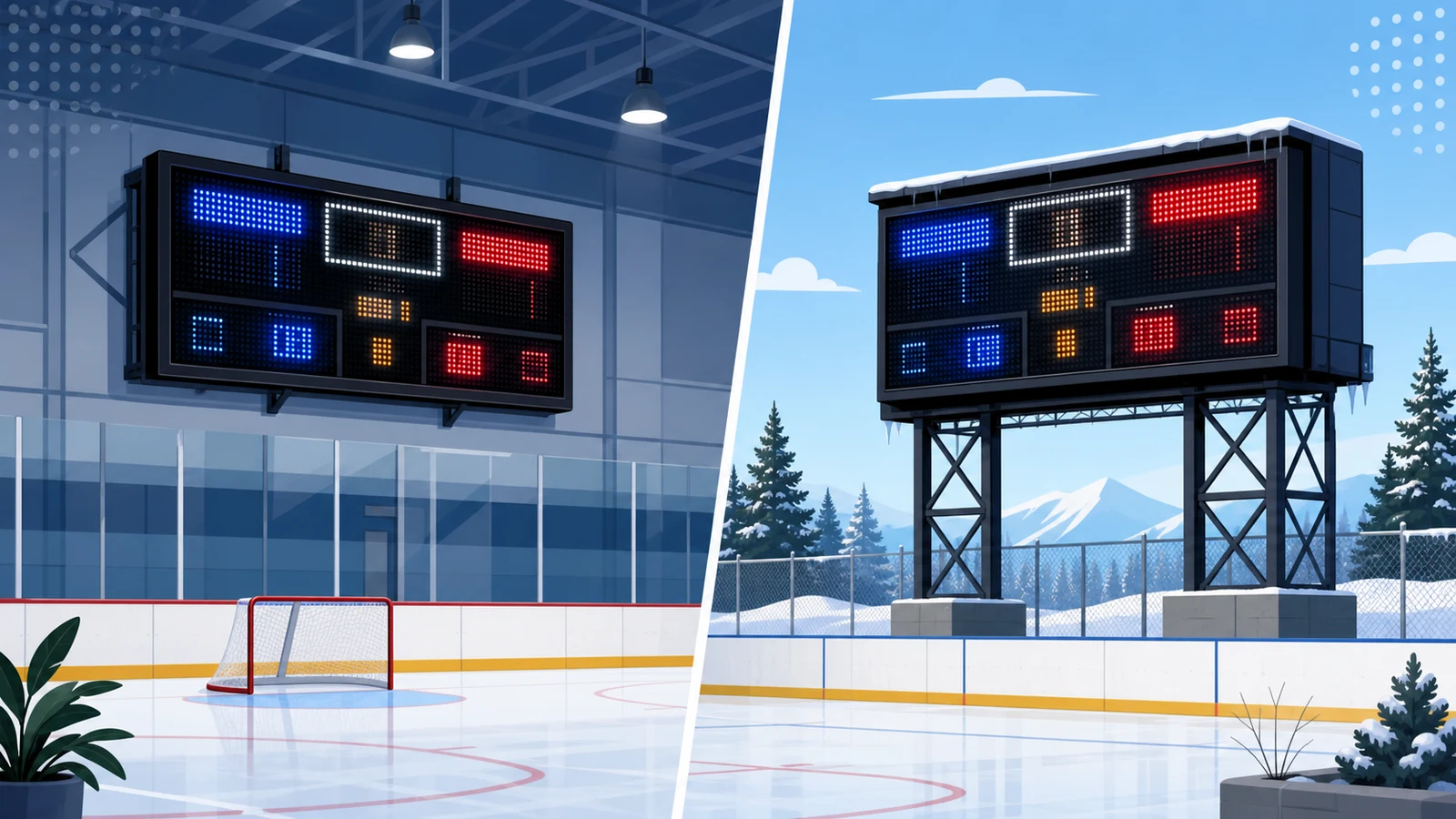
An indoor hockey scoreboard and an outdoor one are different products with different digit heights, different mounting and different instructions - not the same cabinet in two finishes. This page sets the two side by side using the owner's manuals and product pages for the models themselves, including the sentences from each manual that decide the question.
Quick Answer
The short answer: the indoor models use 12 in. and 9 in. digits and hang on wall or ceiling hardware; the outdoor LX7860 uses 11 in. digits throughout and goes on steel posts set in concrete. Neither cabinet is watertight. The indoor manual says plainly not to install or operate the scoreboard outdoors or in a wet location; the outdoor manual says the cabinet handles weather by routing water through it and out of drain holes in the bottom, which must not be blocked.
Two Products, Not Two Finishes
The confusion starts with the word "rated". Buyers expect a weather rating to separate indoor from outdoor equipment, and here it does not, because Electro-Mech assigns no such rating to any of its cabinets. What separates the two is design intent, stated in each product's own manual, and everything practical follows from that: where it hangs, what digits it carries, and how water is expected to behave around it.
| Indoor models | Outdoor model | |
|---|---|---|
| Examples | LX8350, LX8650, LX8750, LX8850 | LX7860 |
| Digit heights | 12 in. and 9 in. | 11 in. throughout |
| Cabinet sizes | 9 ft. x 3 ft. to 12 ft. x 5 ft. | 9 ft. x 5 ft. |
| Weight | 90 to 215 lbs. | 150 lbs. |
| Current at 120 VAC | 1.0 to 2.7 A | 1.8 A |
| Mounting | Wall tabs or ceiling eye bolts | Steel posts in concrete footings |
| Water | Dry environment only | Water routed through the cabinet and out of drain holes |
What the Manuals Actually Say
Two sentences, one from each manual, settle most arguments about which product a rink needs.
The indoor manual: the display is designed for installation and use in a dry environment, and it says directly not to attempt to install or operate the scoreboard outdoors or in a wet location. That is not fine print - it is the design condition of the product.
The outdoor manual: the display is designed for installation and use in a wet environment, meaning rain and other common weather will not hinder its operation when it is installed correctly. And then the sentence that matters most: the scoreboard cabinet is not watertight. Instead, it withstands normal outdoor conditions by routing water through the cabinet and out of drain holes in the bottom.
Two instructions follow from that second sentence, and they are the ones most often missed on site. Do not block the drain holes. And if the scoreboard is installed immediately above something - an ID panel, the ledge of a wall - allow a quarter of an inch or more of clearance beneath the cabinet, or provide matching drain holes in the top of whatever sits below it. A scoreboard that drains onto a sealed surface is a scoreboard that holds water.
Digits and Reading Distance
The digit difference is small on paper and worth understanding in the building. Indoors, 12 in. digits carry Points and the Game Clock while 9 in. digits carry Penalty Times and secondary figures. Outdoors, everything is 11 in.
At roughly 25 feet of viewing distance per inch of digit height, that puts the indoor primary figures at about 300 feet and the secondary figures at about 225, and the outdoor figures at about 275 for every figure on the face. In a municipal rink or a club arena those distances cover the seating; at an outdoor rink where spectators stand along the boards, the practical distance is usually shorter still.
The reason outdoor digits are uniform rather than tiered is the way an outdoor rink is watched: there is rarely a fixed stand with a back row to size against, and the figures a spectator wants at a distance are the same ones they want up close.
Mounting: Wall and Ceiling Against Posts and Concrete
This is the largest practical difference, and it decides who does the installation.
Indoors
- Wall mount. The cabinet has mounting tabs and hangs from two lag bolts, or similar hardware, with a maximum diameter of 3/8 inch. The spacing between them differs with cabinet width, so it is a number to take from the manual for the model being ordered rather than from a neighbouring one.
- Ceiling mount. Two eye bolts along the top of the frame, spaced 60 inches centre to centre, with a 1-inch opening that accepts chain or cable.
- What the structure has to carry. The display plus anything hung with it, including ID panels. The eye bolts in the top of the cabinet are also what the installer uses to lift it off the truck.
- What is not involved. Posts, concrete footings and a crane. Those belong to outdoor installations, and a specification that describes them for a rink wall is describing the wrong product.
Outdoors
- Steel posts. The outdoor manual is explicit that displays are typically installed on steel posts, that the posts must be properly installed, and that the concrete footings need time to cure before they carry the cabinet.
- Footings sized by area and wind. Not by the weight of the cabinet. Local wind load requirements drive the depth.
- A hoist for the lift. And access for whatever brings it.
- Permits, sometimes. Entirely jurisdiction-dependent. Where required, the code may also call for a locally licensed Professional Engineer to review the structure and stamp the drawings, which happens on fewer than one hundred Electro-Mech projects a year.
Power, and Why Both Manuals Ask for a Disconnect
Both products run on ordinary 120 VAC. The indoor cabinet arrives with a six-foot power cord designed to plug into a standard receptacle; the control console needs its own circuit at 0.5 amps; and Electro-Mech recommends a dedicated breaker for the display in both cases. All receptacles must be properly grounded.
The outdoor manual adds a specific recommendation that is worth following indoors too where it is practical: disconnect the scoreboard from power when it is not in use, with a disconnect switch installed on one of the mounting posts beneath the display. In the off position the switch should isolate all load-carrying conductors, not the ground. The reason is lightning and power fluctuation - a nearby strike travels along power cables, and a scoreboard that is electrically isolated between events is a scoreboard that survives the storm.
The same manual makes a plain-language point about outdoor equipment generally: even though the display is designed for outdoor use, it still needs to be kept away from unnecessary exposure, dirt and casual damage. Designed for weather is not the same as indifferent to it.
The Clock and the Console
The outdoor model carries a 4-digit Period Clock that counts up or down, can show the time of day, and can serve as a practice segment timer. The indoor models are run by the same family of consoles - the full-featured 37-key MP-Series or the simplified 15-key MM-Series - and behave the same way at the keypad: four penalties held per team with the top two running, each attached to a player number, an automatic horn at the end of a period, and a Time Out Timer.
The control path is identical in both cases: ScoreLink, the wireless option available on every model, with a working range of about 750 feet; or a shielded two-conductor cable with a drain line, purchased separately, with runs supported to 1,000 feet. Control cable and power never share a conduit.
Why You Cannot Simply Move an Indoor Scoreboard Outdoors
It comes up whenever a facility adds an outdoor sheet and has a spare indoor cabinet in storage. The answer is no, and the reasons are concrete rather than legalistic.
- The manual prohibits it. The indoor product is specified for a dry environment, and its manual says not to install or operate it outdoors or in a wet location.
- The cabinet is not built to route water. The outdoor design moves water through the cabinet and out of drain holes at the bottom. An indoor cabinet has no such path.
- The mounting is wrong. Wall tabs and ceiling eye bolts are not post clamps, and an indoor cabinet is not designed to be clamped to steel posts in the open.
- The power arrangement is wrong. An indoor cabinet plugs into a receptacle with a six-foot cord. An outdoor installation expects a disconnect switch on the post and a properly grounded outdoor circuit.
If a second sheet needs a scoreboard, the outdoor model is the product for it. The indoor cabinet is better redeployed to another indoor surface, or kept as a spare.
What the Outdoor Model Also Does
The LX7860 takes the features of the standard indoor hockey model and presents them in an outdoor package: every digit 11 inches tall, Guest and Home Points to 99, Period to 4, and four 3-digit Penalty Timers - two per team.
Three capabilities on that model go beyond the game itself:
- A clock that counts up or down. The 4-digit Period Clock does either, selected at the console. Leagues differ, and an outdoor facility hosting several of them will use both.
- Time of day. Between games the scoreboard can show the time, which at an outdoor rink is often the most-read thing on the site.
- Practice segment timing. The same practice scheduling the football consoles carry: a stored programme of timed segments run from the console, which turns the scoreboard into a practice clock without any additional hardware.
None of those changes the sizing or the mounting. They change how many hours a week the scoreboard is doing something useful, which is a fair thing to weigh when a facility is deciding between one scoreboard and none.
ID Panels, Indoors and Out
ID panels - the panels carrying a rink name, a club crest or a sponsor's message - behave differently on each side of this line, and the difference is physical rather than commercial.
Indoors the panel is part of the load hanging from the wall or the ceiling, so it belongs in the structural conversation from the start. A model with a built-in identification panel on the left, the right or both is designated -L, -R or -LR and is quoted as its own model, because it adds cabinet, weight and mounting hardware positions.
Outdoors the same panel adds area to the sign, and area is what footings are sized against. A scoreboard with panels either side presents considerably more face to the wind than the cabinet alone, which feeds straight back into the depth of the footings and the size of the posts. It is also the case where the drainage clearance matters: a panel mounted immediately below the scoreboard needs the quarter inch of gap, or matching drain holes in its own top edge.
In both cases the panels are the standard way a purchase gets offset, because the space beside the scoreboard is where the crowd is already looking. Decide about them before the structural work is designed rather than after.
Covered Rinks, and the Grey Area
The clean cases are easy: a heated indoor arena takes an indoor scoreboard, an open-air sheet takes the outdoor one. What causes trouble is everything in between, and the test is not whether the structure has a roof but whether weather reaches the scoreboard position.
- A roof with open sides. Rain blows sideways. If driven rain can reach the cabinet, the position is a wet location regardless of what is overhead.
- An unheated barn. Condensation is water. A building that swings from cold to warm over a weekend puts moisture on cold surfaces, and an indoor cabinet in that position is being asked to do something it is not specified for.
- A covered position at an outdoor rink. Often the best of both, but the decision should be made by looking at the position in bad weather rather than in July.
- A concourse or lobby display. Genuinely indoor, and a good place for auxiliary displays or a locker room clock repeating the Period Clock.
When the answer is genuinely uncertain, the outdoor product is the conservative choice: it is designed for water to pass through it, and putting it in a dry building costs nothing except the digit arrangement being uniform rather than tiered.
What Each One Asks For Afterwards
Neither product needs much, but what they need is different.
Outdoors
- Keep the drain holes clear. This is the whole maintenance story in one line. Leaves, nests and paint all block drainage, and a cabinet that cannot drain holds water it was designed to shed.
- Check the clearance below. If anything has been added beneath the scoreboard since installation - an ID panel, a sign, a ledge - confirm there is still a quarter inch of gap or matching drain holes.
- Use the disconnect. Isolating the scoreboard between seasons or between events protects the electronics from surges travelling along the power line.
- Keep dirt and casual damage away. The manual makes the point directly: designed for outdoor use is not the same as indifferent to abuse.
Indoors
- Keep it dry. Which mostly means not letting building work, roof leaks or cleaning water reach it.
- Check the fixings. The cabinet hangs on two bolts or two eye bolts. Anything hung with it - ID panels especially - is part of the load.
- Mind the brightness. Fifty selectable levels from the console. A rink is a dark building, and a scoreboard set for the house lights is uncomfortable during a game.
A Checklist for the Site Visit
Fifteen minutes at the position answers most of the specification. Take a tape measure and go at a time when the building is doing what it normally does.
- Can weather reach this spot? Look up, look sideways, and ask what happens in a storm from the prevailing direction.
- What is behind or above the position? Wall structure or roof structure, and who can confirm what it carries.
- How far is the farthest spectator? At 25 feet per inch of digit height, that decides whether 12 in. or 11 in. figures are enough.
- Where does power come from? And is there anywhere sensible for a disconnect switch.
- Where will the console sit? Test the wireless link from that exact position rather than from the middle of the ice.
- What sits directly below? If anything does, the outdoor drainage clearance applies.
Bring those six answers to a sales representative and the product choice takes one conversation.
One practical consequence of all this for a facility running both an indoor arena and an outdoor sheet: the two scoreboards are separate purchases with separate installations, but they can share a way of working. The consoles come from the same family, the wireless link is the same option at the same range, the penalty behaviour at the keypad is identical, and an operator trained on one is trained on the other. What does not transfer is the hardware itself - the cabinet, the mounting and the drainage arrangement are specific to where each one lives, and that is the line this whole page is drawing.
What Neither One Claims
- No IP rating and no weatherproof rating. On either product. What the manuals give instead is behaviour: the outdoor cabinet routes water through and out, and the indoor one is specified for a dry environment.
- Neither cabinet is watertight. The outdoor one drains; the indoor one is meant to stay dry.
- No temperature ratings. No operating range is published, in either direction - which is worth stating plainly for a sport played in cold buildings.
- No 100,000-hour LED modules. Electro-Mech does not make LED modules and makes no lifetime claim about any component or assembly other than individual LEDs, where the statement is that the majority will keep working while holding at least half their original brightness over that span.
- No construction grades. No arena-grade or facility-grade tier exists on either side of the indoor/outdoor line. The cabinets are aluminum throughout.
- No power play indicator and no overtime digit. On any model in the hockey line. The Period counts to four.
The one durability claim the company does make is about expected life, and it differs by where the display lives: 15 years outdoors, 20 years indoors. For a rink running both, that is one more line on which the indoor and the outdoor product are not the same purchase.
A last note for facilities that already own one of each. Keep the two owner's manuals where the maintenance staff can find them, because the instructions genuinely differ: the outdoor manual is the one that tells you to keep the drain holes clear and to leave clearance below the cabinet, and the indoor manual is the one that specifies the bolt diameter and spacing the wall fixings have to meet. Neither instruction is guessable from the other, and both are the kind of detail that gets lost between the season a scoreboard is installed and the season somebody decides to hang a sponsor panel underneath it.
Choosing Between Them
The decision is usually made by the building rather than by preference, but three questions settle the cases where it is genuinely open.
- Is the surface covered? A covered outdoor rink is still an outdoor installation if weather reaches the scoreboard position. Rain blowing sideways under a roof is a wet location.
- Where can it hang? If there is no wall or roof structure to take a cabinet, the answer is posts, and posts mean the outdoor product.
- What has to be on the face? Penalty Times and Shots on Goal are indoor-cabinet features on the 12 ft. LX8850. The outdoor model carries the standard indoor feature set in an outdoor package, so a rink that needs the full statistic set outdoors should confirm the configuration on the quote rather than assume it.
Finally, a word for facilities planning both at once. If an indoor arena and an outdoor sheet are being equipped in the same project, order them as one conversation rather than two: the consoles come from the same family, the wireless option is the same at the same range, and a single operator can be trained for both. What stays separate is everything physical - the cabinet, the mounting hardware, the drainage arrangement and the electrical work - and keeping those distinct in the specification is what prevents an indoor cabinet ending up on a post because the paperwork treated the two as interchangeable.
Key Takeaways
- Indoor and outdoor hockey scoreboards are different products: 12 in. and 9 in. digits on wall or ceiling mounts, against 11 in. digits on steel posts.
- Neither cabinet is watertight. The outdoor one routes water through the cabinet and out of drain holes that must not be blocked.
- If an outdoor scoreboard sits immediately above an ID panel or a ledge, leave a quarter inch of clearance or provide matching drain holes below.
- The indoor manual says explicitly not to install or operate the scoreboard outdoors or in a wet location.
- Indoor mounting is two lag bolts of at most 3/8 in. at 84 in. centres on the LX8650, or two ceiling eye bolts at 60 in. centres.
- Both run on 120 VAC with the console on its own circuit, and both manuals recommend a dedicated breaker and disconnecting power when the scoreboard is not in use.
- Neither carries an IP rating, a temperature rating or a construction grade, and neither has a power play indicator or an overtime digit.
The useful way to hold this distinction is that the outdoor scoreboard is not a tougher version of the indoor one - it is a cabinet designed around water having somewhere to go. Decide where the scoreboard hangs and what the weather can reach, and the product follows.
Not sure which one your rink needs? Request a quote from Electro-Mech and describe where the scoreboard will hang and whether weather reaches that position.
Frequently Asked Questions
Can I install an indoor hockey scoreboard outdoors?
No. The indoor product is designed for a dry environment, and its owner's manual says directly not to install or operate it outdoors or in a wet location. The cabinet has no path for water to drain and its mounting hardware is intended for a wall or ceiling.
Is the outdoor hockey scoreboard watertight?
No, and the manual says so. It is designed for a wet environment in the sense that it routes water through the cabinet and out of drain holes in the bottom. Those holes must not be blocked.
What if the outdoor scoreboard sits directly above an ID panel?
Allow a quarter of an inch or more of clearance below the cabinet, or provide matching drain holes in the top of whatever sits beneath it. Otherwise the water leaving the scoreboard has nowhere to go.
What are the digit heights indoors and outdoors?
Indoor models use 12 in. digits for Points and the Game Clock and 9 in. for Penalty Times and secondary figures. The outdoor LX7860 uses 11 in. digits throughout.
How does an indoor hockey scoreboard mount?
On wall mounting tabs, hanging from two lag bolts of at most 3/8 in. diameter - 84 in. centre to centre on the LX8650 - or suspended from two eye bolts along the top of the frame at 60 in. centres, with a 1-inch opening for chain or cable.
How does the outdoor one mount?
On steel posts, with concrete footings that must be given time to cure before they carry the cabinet. Footings are sized against the surface area of the sign and the local wind load requirement.
What electrical service do they need?
Both run on ordinary 120 VAC. The indoor cabinet arrives with a six-foot cord for a standard receptacle, the console needs its own circuit at 0.5 amps, and Electro-Mech recommends a dedicated breaker. All receptacles must be properly grounded.
Why do the manuals recommend a disconnect switch?
To isolate the scoreboard from the power line when it is not in use, which protects the electronics from nearby lightning strikes and other fluctuations travelling along the cables. Outdoors the recommended position is on one of the mounting posts beneath the display.
Do either of them carry a weatherproof rating?
No. Electro-Mech assigns no IP or weatherproof rating to any cabinet, indoor or outdoor. The manuals describe how each cabinet behaves in water rather than rating it: the outdoor one drains, the indoor one is for a dry environment.
AI Summary
AI Summary: Electro-Mech indoor and outdoor hockey scoreboards are different products. Indoors: LX8350, LX8650, LX8750 and LX8850, 9 ft. x 3 ft. to 12 ft. x 5 ft., 90 to 215 lbs., 12 in. and 9 in. digits, hung on wall tabs from two lag bolts of at most 3/8 in. at the spacing that model's manual gives, or from two ceiling eye bolts at 60 in. centres; the manual says not to install or operate them outdoors or in a wet location. Outdoors: the LX7860, 9 ft. x 5 ft., 150 lbs., 11 in. digits throughout, on steel posts in cured concrete footings; its cabinet is not watertight but routes water out through drain holes that must not be blocked, with a quarter inch of clearance required if it sits above an ID panel or ledge. Both run on 120 VAC with the console on its own circuit, both manuals recommend a dedicated breaker and a disconnect switch, and neither carries an IP rating, a temperature rating or a construction grade.