
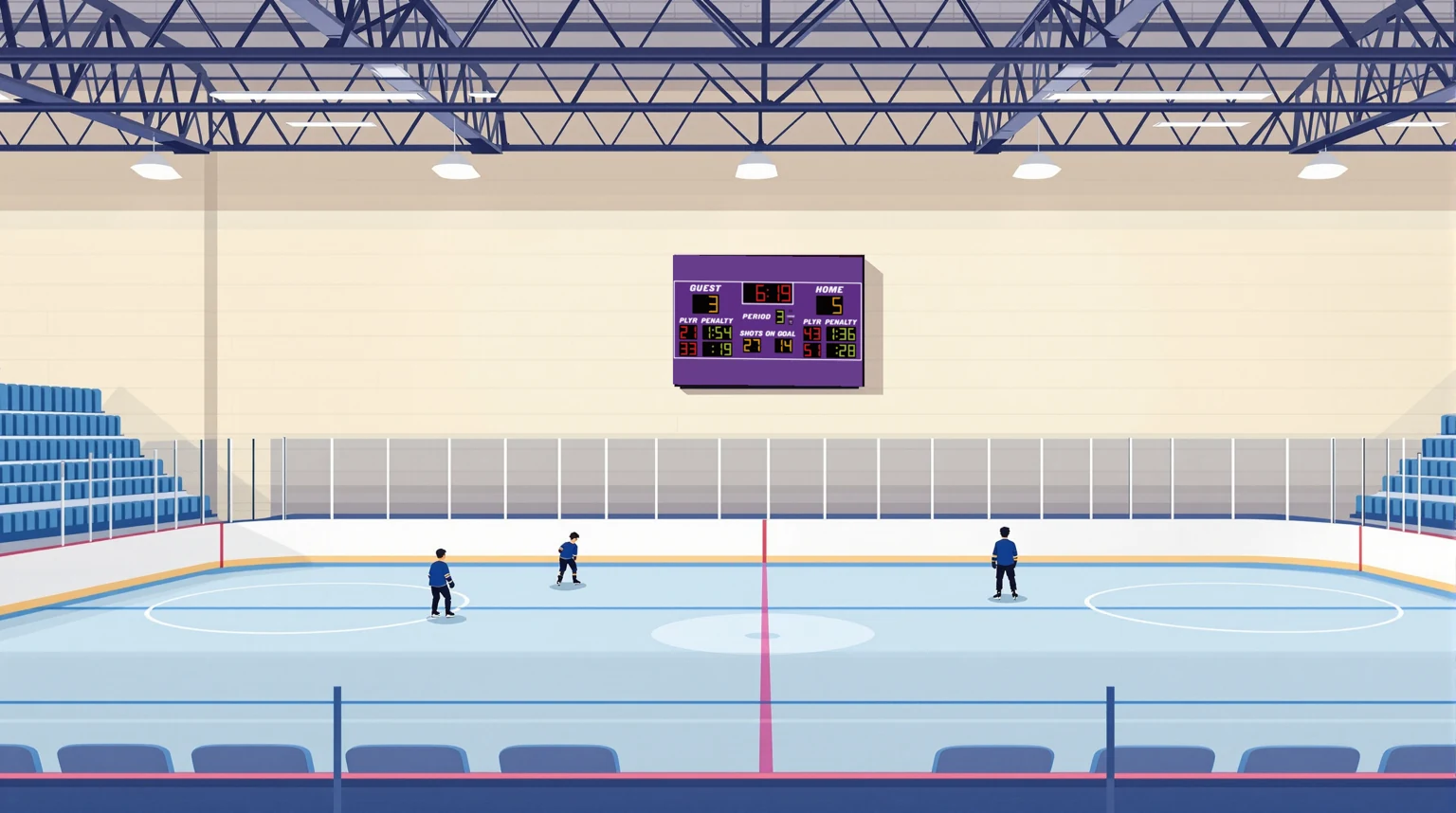
Electro-Mech builds four indoor Hockey scoreboards. The smallest shows Time, Period and Points; the largest adds Shots On Goal and a pair of Penalty Timers for each team. This page sets out what each model is, what the control console does behind it, and what our own sales and shipping records say about the facilities that have ordered them since 2001.
The short answer
The Hockey line runs from the Model LX8350, a 9 ft x 3 ft display showing Time, Period and Points, to the Model LX8850, a 12 ft x 5 ft display that adds Shots On Goal and two Penalty Timers per team with the Player number beside each Penalty. All four use 12-inch and 9-inch digits and run on 120 VAC. In our records, the facilities that order them are municipal rinks, ice centers and amateur hockey associations - not schools.
The four indoor Hockey scoreboards, and what each one shows
The four models differ in cabinet size and in how many functions the face carries. Every one of them uses the same digit sizes and the same 120 VAC supply, so the practical questions when choosing are how much wall you have, how far away the far seats are, and whether you need Penalty Timers and Shots On Goal on the scoreboard itself.
| Model | Cabinet | Digits | Weight | Power |
|---|---|---|---|---|
| LX8350 | 9 ft x 3 ft | 12 in, 9 in | 90 lbs | 120 VAC, 1.0 A |
| LX8650 | 9 ft x 5 ft | 12 in, 9 in | 145 lbs | 120 VAC, 1.9 A |
| LX8750 | 9 ft x 5 ft | 12 in, 9 in | 145 lbs | 120 VAC, 2.2 A |
| LX8850 | 12 ft x 5 ft | 12 in, 9 in | 215 lbs | 120 VAC, 2.7 A |
Our product page calls the LX8350 our most versatile indoor scoreboard, and it is the most straightforward of the four: Time, Period and Points, in a cabinet light enough at 90 lbs. to go on most walls without special structural work. Its simplicity is the point - the same face keeps score for basketball or volleyball just as readily, because nothing on it is specific to hockey. In the ice-facility record further down, the LX8650 appears more often than it does. The LX8850 is the top of the line and the only one that carries the full Hockey feature set on its face.
The scoreboard in the illustration above is the LX8850, the largest of the four, as the catalogue photographs it: Guest and Home Points, Period, Shots On Goal, and a pair of Penalty Timers per team with the Player number beside each one.
A note on the size, because it is easy to picture these wrong: the widest of the four is twelve feet across. A hockey rink is 200 feet long. These are wall-mounted or ceiling-hung scoreboards sized for community rinks and ice centers, not the centre-hung structures seen in professional arenas.
How Penalty Timers work on an Electro-Mech scoreboard
On the LX8850, each team gets a pair of Penalty Timers. Each one counts down the time remaining on a Penalty and shows the number of the Player it was assigned to, so the Penalty and the Player stay together on the face rather than being tracked on paper at the scorer's table.
Behind the display there is more capacity than the face shows. The Hockey software in the control console tracks up to eight Players and Penalty Times - four for each team - while the typical scoreboard face shows two lines per team. The console holds the queue; the scoreboard shows what is running.
One point about labelling that buyers often ask about: we do not label individual Penalty Timers as belonging to a home or a guest bench. Every function on one side of the display sits under the GUEST caption and every function on the other side under HOME - Points, Shots On Goal and Penalty Times all share the team caption on their side.
The two 9 ft x 5 ft models, and what separates them
The LX8650 and the LX8750 share a cabinet: 9 ft x 5 ft, 145 lbs, the same 12-inch and 9-inch digits. On a wall they look alike. What separates them is one function - the LX8750 carries Shots On Goal, and the LX8650 does not. That is the whole decision, and it is worth making deliberately, because a rink that wants the statistic on the board later cannot add it to a cabinet that was not built for it.
The electrical difference follows the extra digits: the LX8650 draws 1.9 amps at 120 VAC and the LX8750 draws 2.2. Both sit well inside a standard circuit, but the figure to give an electrician is the one for the model actually ordered.
The LX8650's own catalogue description points at where the design comes from: a long line of Electro-Mech hockey scoreboards with the same layout, sharing traits with the company's basketball designs - including the three-colour LED scheme that lets an eye find the number it wants without reading the whole face.
The outdoor model, and the one built to hang beside another
Two more displays appear in the ice record often enough to belong in any shortlist, and neither is one of the four indoor models.
The LX7860 is the outdoor version of the indoor hockey layout, and it is the single most ordered display in the ice-facility record. It is 9 ft x 5 ft and 150 lbs, drawing 1.8 amps, with every digit 11 inches tall rather than the mixed 12 and 9 of the indoor cabinets. Its 4-digit Period Clock counts up or down, shows the Time of Day, and doubles as a Practice Segment Timer; Guest and Home Points run to 99, Period to 4, and it carries four 3-digit Penalty Timers - two per team. For an outdoor rink, or a covered one open to the weather, it is the model that reads correctly in daylight.
The LX8440 is the odd one: 16 ft x 3 ft, 150 lbs, 2.5 amps - a long, shallow cabinet built to work as a secondary display when a larger scoreboard such as the LX8850 holds the main sightline. It can also carry a rink on its own, and it is designed to sit inside a wide band of displays alongside static advertising panels and video panels. Every one of its entries in the ice record carries the LX designation, which makes it the newest habit in that record rather than a legacy of older buying.
Which model fits a given rink
Four questions settle it, in this order:
- Indoors or out? The indoor four use three LED colours - green, red and amber - so the eye can separate Time from Points from Penalty on a busy face. The outdoor LX7860 uses super-bright LEDs configured for the widest viewing angle instead, in red or amber. That choice is made by the building, not by preference.
- Do Penalty Timers belong on the face? The LX8850 puts a pair per team on the board with the Player number beside each. The smaller indoor models leave the queue in the console and the paper at the scorer's table.
- Is Shots On Goal wanted? If yes, the choice narrows to the LX8750 among the 9 ft x 5 ft cabinets, or the LX8850 above them.
- How much wall is there, and how far is the far seat? Twelve feet is the widest of the four. Every one of them uses 12-inch and 9-inch digits, so the reading distance is the same across the line - what changes with the bigger cabinet is how much the face carries, not how far it reads.
One consequence of that last point is worth stating plainly, because it saves a conversation: buying a wider hockey scoreboard does not buy a longer sightline. If the far seats in a rink cannot read a 9-inch digit, they will not read it on the LX8850 either.
What the sales and shipping record shows about who buys them
Electro-Mech keeps a record of what it has sold and shipped - organization, model, city and ship date. That record has sport codes for baseball, basketball and football, and everything else falls under a general code, so hockey cannot be counted directly. What can be counted is the set of organizations whose names identify them as ice facilities or hockey programs: ice arenas, ice centers, ice houses, rinks, skating centers and hockey clubs and associations.
By that reading the record holds 100 entries across 86 such organizations in 33 states, shipped between 2001 and 2025. Two things stand out.
The geography is northern. New Jersey and Pennsylvania lead with 11 entries each, then Massachusetts with 9, New York and North Carolina with 6 each, and Connecticut with 5 - a different map from the company's baseball and football records, which are concentrated in the southeast.
| Model | Entries in the ice-facility record | Of those, ordered under the LX designation |
|---|---|---|
| 8650 family | 22 | 10 |
| 7860 family | 21 | 15 |
| 8850 family | 19 | 10 |
| 8350 family | 9 | 7 |
| 8440 family | 9 | 9 |
| 6630 family | 6 | 4 |
Those counts are model families rather than single part numbers: the record spells the same display both with and without the LX prefix, and the first column counts both spellings, with the LX share in the second. The 8650 family is the most ordered display in the ice record, and the 7860 - the outdoor version of the indoor layout - is second.
The buyers are rinks and clubs, not schools. Terry Conners Rink in Stamford, Connecticut; Campion Ice House in Hailey, Idaho; Lexington Ice Center in Kentucky; Clearwater Ice Arena in Florida; The Ice Forum in Gainesville, Georgia; Laramie Amateur Hockey Club in Wyoming; Tomah Youth Hockey in Wisconsin; Pueblo Bulls Hockey Club in Colorado. Alongside the ice facilities the record also holds roller and street hockey programs - Foxchase Roller Hockey in Philadelphia, West Deptford Street Hockey in New Jersey - which order soccer-style displays rather than the Hockey models.
Thirteen of those organizations appear more than once, and the pattern is usually a scoreboard and a second display ordered together in the same year: Terry Conners Rink took an LX8350 and an LX8850 in 2017, Laramie Amateur Hockey Club an LX8350 and an LX8850 in 2023, Lexington Ice Center an LX7406 and an LX8650 in 2022.
One caveat on all of the above, and it applies to every number on this page: these are records of what was sold and shipped. A shipped scoreboard can sit in storage for months before it goes up, and the record does not say where a display ended up or whether it is still in use.
The console behind all four
The scoreboard is the visible half of the purchase. The console is the half a scorekeeper actually touches, and it comes matched to the model rather than chosen separately - there is nothing to configure and no codes to enter before a first game.
Two of its capabilities are worth knowing before the order, because both change what a rink can do with the display it already has.
The first is the penalty queue described above. A rink that expects four-on-four situations regularly is not limited by the board so much as by what the board can show at once, which is a different thing from what the console is holding.
The second is the Practice Segment Timer, which sits in the same console software. It lets a coach build a practice schedule in advance and run it from the scoreboard clock, so a session moves between drills on the board rather than on a whistle and a wristwatch. It arrived on the football side of the line years ago and carries across; the LX8350's console has it, and so does the outdoor LX7860, whose 4-digit Period Clock can also count up, count down or show the time of day.
Electronic Team Names are an upgrade rather than a separate device: the software that drives them is built into the standard hockey console, so a rink that orders them does not gain a second keyboard or a second operator. The character height is 9 pixels, and 14 on some of the larger models - taller characters than a typical 8-pixel text line, which is what makes a visiting club's name read as a name rather than as a row of blocks from across the ice.
What the console does not do is turn one scoreboard into another sport's scoreboard. There is no mode that relabels a hockey face for basketball or volleyball. Where a building genuinely needs one display for several activities, the practical answer is the simplest model in the line - a face carrying Time, Period and Points reads correctly for more than one game precisely because it carries nothing specific to any of them.
How rinks buy, read from the same record
The shape of the record is as useful as its totals, and three patterns in it are worth a facility manager's attention.
Ordering clusters into a single year. Fourteen organizations appear in the record more than once, and twelve of those took everything in the same year - a scoreboard and a second display together rather than one now and one later. Terry Conners Rink in Stamford, Connecticut took an LX8350 and an LX8850 in 2017; Laramie Amateur Hockey Club did the same pairing in 2023; Lexington Ice Center took an LX7406 and an LX8650 in 2022. If a rink expects to want a second display at the far end, ordering both at once is the pattern the record shows, and it puts one lift visit on the schedule instead of two.
The middle decade dominates. Twenty entries fall in the 2000s, fifty-six in the 2010s and twenty-four so far in the 2020s. That distribution says more about when community rinks were built and renovated than about the product line, and it is the reason a rink built in the 2010s is more likely to be facing a control-console conversation now than a display one.
Roller and street hockey buy differently. Sixteen of the hundred entries come from roller, inline and street hockey programs, and they order the outdoor 7860 or a soccer-style display rather than the indoor hockey cabinets - an outdoor face reads in daylight and does not need the three-colour indoor scheme. The most recent entries in the record run the same way: an LX7740 to an inline league in Toledo in 2024, an LX6320 to a youth hockey program in South Carolina in 2025.
Geography deserves the same caution as everywhere else in this record. Thirteen of the thirty-three states hold exactly one entry, so a single order can make a state look like a market. The northern concentration is real; the ranking below the top five is thin.
What to settle before the order goes in
Most of what delays a rink installation is decided months before the crate arrives, and none of it requires a site visit to work out.
- Where the display hangs, and on what. Indoor models attach to a wall or hang from the ceiling structure, and the structure has to carry the cabinet plus any ID Panel ordered with it. A 215 lb LX8850 with a panel above it is a different conversation with a building engineer than an 89 lb LX8350 on a block wall.
- Whether the face will be seen from both ends. Every single-face indoor model can be built four-sided and centre-hung instead, which is the answer for a building where seating wraps the ice. That is a decision at order time, not a retrofit.
- How the console reaches the display. ScoreLink carries the signal up to 750 feet without a cable run - useful in a rink where the scorer's table sits across the ice from the scoreboard. The console still needs power where it sits.
- Whether an ID Panel is part of the plan. For a good many rinks the sponsor panel is what funds the scoreboard, and it changes cabinet size, weight and mounting - so it belongs in the first quote rather than the second.
- Who operates it. The hockey console tracks eight penalties at once, four per team, and the face shows the top two per side. A rink running youth games with volunteer scorekeepers may want the simpler face for that reason alone.
Indoor and outdoor: what actually differs
The difference between our indoor and outdoor Hockey scoreboards is the LEDs, not the cabinet.
Indoor Hockey models use a three-colour arrangement - Green, Red and Amber digits - which helps the eye find the figure it is looking for on a face carrying Time, Period, Points, Shots On Goal and Penalty Times at once. Outdoor models use super-bright LEDs configured for the widest possible viewing angle, in Red or Amber.
Electronic Team Names are an upgrade available on all of our indoor Hockey scoreboards and on most outdoor models; the portable scoreboards and the compact LX7860 are the exceptions. The software that drives them is built into the standard Hockey control console, so no separate keyboard is needed. Our ETNs use a 9-pixel character height - 14 pixels on some larger models - which fits more legible letters across the same space than a typical 8-pixel text line.
What does not differ: all Electro-Mech scoreboard cabinets are aluminium, indoor and outdoor alike.
Mounting, four-sided configurations and ID Panels
Indoor Hockey models are usually attached to a wall, though they can be suspended from the ceiling instead. Every single-face indoor model can also be built as a four-faced, centre-hung configuration, which keeps the information facing the ice from every side of the building.
Most of our Hockey scoreboards can be built with ID Panels - a built-in area in an expanded cabinet for sponsor advertising, team branding or the facility name. A panel along the top can be curved into an arch or a dome, and an open-frame truss panel is available where a more prominent structure is wanted. For a good many rinks this is the part of the purchase that pays for the rest of it.
What Electro-Mech does not offer
It is worth being direct about the boundaries of the line, because they decide whether these models fit a facility at all.
- No sport-mode switching. An Electro-Mech Hockey scoreboard is a Hockey scoreboard. There is no console setting that turns its face into a basketball, volleyball or wrestling layout. Facilities that need one display to change its function between sports should say so early in the conversation.
- No power play indicator. It is not a feature of our Hockey scoreboards.
- Period counts to 4. There is no separate overtime indication on the Period digit.
- No IP rating and no temperature rating. Our cabinets are not sealed - they have drainage holes, because water gets into an outdoor cabinet and has to leave again. We do not publish an ingress-protection figure or an operating-temperature range for them.
- No pricing online. Configuration decides the price, so quotes come from the sales team rather than from a page.
- ScoreLink is a wireless communication system, not a control system and not a model. It is an optional upgrade available with any of our scoreboards, it carries the signal between the console and the display at a distance of up to 750 feet, and the console itself still needs power at the scorer's table.
Frequently asked questions
Which Electro-Mech Hockey scoreboard has Penalty Timers?
The Model LX8850. It carries a pair of Penalty Timers for each team, each counting down the time remaining on a Penalty and showing the number of the Player it was assigned to, along with Shots On Goal. The LX8350 shows Time, Period and Points.
How many Penalties can the console track at once?
The Hockey software in the control console tracks up to eight Players and Penalty Times, four for each team, while the typical scoreboard face shows two lines per team.
How big are the Hockey scoreboards?
From 9 ft x 3 ft for the LX8350 to 12 ft x 5 ft for the LX8850, with 12-inch and 9-inch digits throughout. Weights run from 85 lbs to 215 lbs, and all four models run on 120 VAC.
What kinds of facilities appear in the Hockey record?
Municipal rinks, ice centers and ice houses, amateur and youth hockey associations, and roller and street hockey programs. Across 100 entries between 2001 and 2025 the record holds no high school or college ice facility.
Can one of these scoreboards also serve another sport?
Not by switching modes - the face is built for Hockey. Where a facility wants one display for several activities, the practical answer is usually a simpler scoreboard with Time, Period and Points, which reads correctly for more than one sport because it does not carry sport-specific functions.
Which hockey display appears most often in the record?
The 8650 family, with 22 entries, just ahead of the outdoor 7860 at 21. Both counts include the pre-LX spellings of the same display; of the 8650 entries 10 carry the LX designation, and of the 7860 entries 15 do. The largest indoor model, the 8850, follows at 19.
Can a rink run a second display showing the same game?
Yes, and the LX8440 exists for it: a 16 ft x 3 ft, 150 lb cabinet built to work alongside a larger scoreboard such as the LX8850, or to carry a rink on its own. In the ice record every one of its entries was ordered under the LX designation, and the most recent went to an ice house in North Carolina in 2025.
Can the scoreboard be operated without running cable to the scorer's table?
Yes, with the ScoreLink wireless communication system, an optional upgrade that carries the signal up to 750 feet. The control console still needs power where it sits.
Working out which model fits your rink?
Electro-Mech has built scoreboards in Wrightsville, Georgia since 1963. Tell our sales team the size of the space, the mounting you have in mind and whether you need Penalty Timers and Shots On Goal on the face, and they will put a configuration and a quote together for you.