
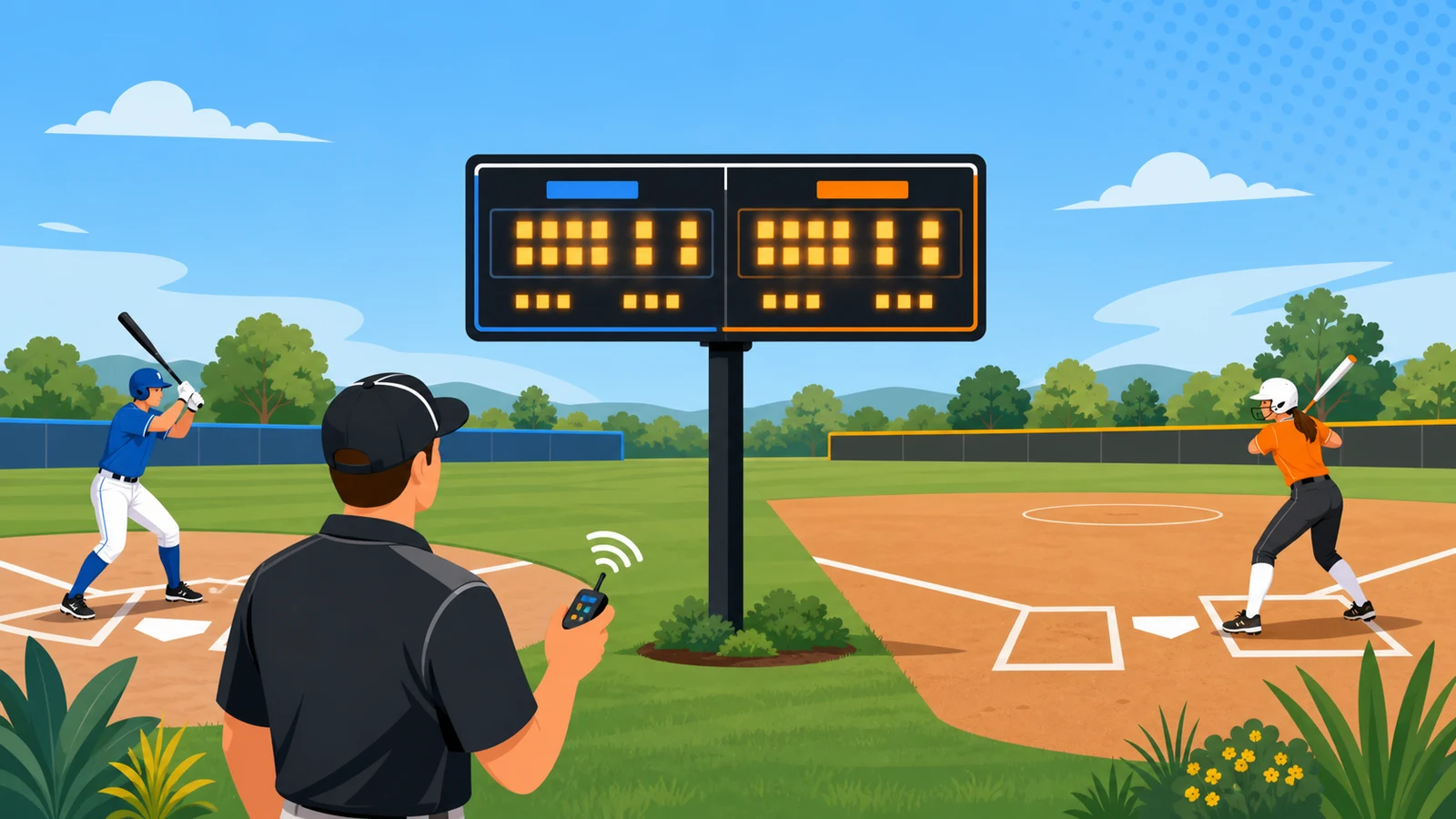
A baseball scoreboard and a softball scoreboard from Electro-Mech are frequently the same cabinet. Several models are listed as baseball and softball scoreboards on one frame, and what changes between the two sports is the caption set and the number of innings - not the cabinet, not the mounting, and not the electrical service. This page sets out precisely what is shared and what is not, so a park running both programmes orders once rather than twice.
Quick Answer
The short answer: the LX1340 and LX1341 are baseball and softball scoreboards on the same 10 ft. x 5 ft. cabinet at 170 lbs. Both sports need Runs, the Inning and Ball, Strike and Out counts, and both are read by the same console. The differences that reach the specification are the captions printed on the face and how many innings the scoreboard needs to show - so those are the two things to confirm on the quote.
The Same Cabinet, a Different Caption Set
The phrase "baseball/softball scoreboard" appears throughout this catalogue, and it is meant literally: the cabinet, the digits, the mounting hardware and the power requirement are the same product. What differs is what is printed beside each figure and how many innings the layout carries.
That matters commercially for exactly one reason: a park with a baseball diamond and a softball diamond is making one purchasing decision about two signs, not two unrelated decisions. The specification conversation is the same, the installer is the same, and the console behaves the same way at either field.
What Is Identical
- The cabinet and the frame. Same dimensions, same weight, same aluminum construction.
- The digits. Same heights, same layout logic - Runs and the Inning in the tallest figures, the counts in bullet-style indicators or smaller digits depending on the model.
- The mounting. Two steel posts set in concrete footings, cabinets clamped to the posts. No anchor bolts, no bolt pattern to match.
- The electrical service. Ordinary 120 VAC. The line draws 0.8 to 6.6 amps depending on cabinet size, with the console on its own circuit.
- The control path. ScoreLink wireless at about 750 feet, or a shielded two-conductor cable with a drain line at up to 1,000 feet. Control cable and power never share a conduit.
- The console. Already matched to the model, configured for the sport, with no codes to enter.
Because all of that is shared, the practical difference between a baseball order and a softball order at the same park is smaller than most people assume - which is why it pays to specify both at once.
What Actually Differs
- The captions. The words printed beside each figure. This is the part that is physical rather than software, and it is specified at the time of order.
- The number of innings. A softball layout does not need the same inning count as a baseball one, and on the models that show Runs by Inning that is a difference in the face itself rather than a setting.
- The viewing distance, usually. A softball diamond is a smaller field, so the distance from the scoreboard position to the farthest seat is often shorter - which can mean a smaller cabinet or shorter digits are genuinely sufficient.
- What the programme wants displayed. Youth softball frequently wants Runs, the Inning and the counts and nothing more; a high school baseball programme is more likely to ask for Pitch Count or a full line score.
Nothing in that list is a mode on the console. The scoreboard is built for the sport it is ordered for, and the sport it is ordered for is a line on the purchase order rather than a switch on the wall.
The Models Built for Both
| Model | Cabinet Size | Digit Heights | Weight | Current at 120 VAC | Note |
|---|---|---|---|---|---|
| LX1340 | 10 ft. x 5 ft. | 18 in. | 170 lbs. | 1.4 A | Baseball and softball on one frame, with a 2-Digit Timer whose bullet blinks once a second while the clock runs |
| LX1341 | 10 ft. x 5 ft. | 18 in. | 170 lbs. | 1.6 A | The companion model in the same series |
These two are based on a design that goes back to the 1980s, and their popularity is the reason: 10 ft. x 5 ft. with 18 in. digits for Scores, Inning and Time, and bullet-style LED clusters for Ball, Strike and Out counts. In the sales record the LX1340 has 420 entries, which puts it fourth among all baseball-line models. These counts are model families rather than single part numbers: the record spells the same display both with and without the LX prefix, and both spellings are counted together here.
Around them sit the rest of the line, which serves either sport on the same principle: the 6 ft. x 3 ft. LX1050 at 78 lbs. at the small end, the 8 ft. x 4 ft. LX1030, the 10 ft. x 5 ft. LX1060, and upward through the cabinets that add Pitch Count, a Timer, or a full line score with Hits, Errors and Fielder Position.
Sizing for Two Diamonds
Where a park runs both sports, the two scoreboards are frequently different sizes, and that is the correct outcome rather than an inconsistency.
Size each one from its own farthest seat at roughly 25 feet of viewing distance per inch of digit height. A 15 in. digit reads to about 375 feet and an 18 in. digit to about 450. The smallest cabinet in the line is recommended only where the viewing distance stays under 250 feet, because its captions are necessarily short.
Two practical points follow. A smaller diamond with seating close to the backstop can be well served by a cabinet that would be undersized on the baseball field next to it. And if both diamonds share a spectator area - a common arrangement at a park - measure from that shared area to each scoreboard position rather than assuming symmetry.
The Console and the Scorer
Both sports are run from the same family of consoles - the full-featured 37-key MP-Series or the simplified 15-key MM-Series, matched to the model at the factory. Most of the smaller cabinets ship with the MM-Series, and an MM-Series can be upgraded to an MP-Series though not the reverse.
What that means for a park with two diamonds is that a volunteer trained at one field is trained for the other. The keys do the same things: Runs, the Inning, the counts, the timer if the cabinet carries one. The only thing that differs is what the printed captions call each figure.
One console detail worth knowing at either sport: two features of the larger console do not apply to this line at all. Practice Segment Timer mode and tenth-of-a-second display are not available for baseball, so paying for the larger console to get them would be paying for nothing.
What Both Scoreboards Show, Step by Step
The face is built up the same way for either sport, and knowing the sequence makes the quote readable.
- Runs and the Inning. The tallest digits on the cabinet. On the popular 10 ft. x 5 ft. models they are 18 inches.
- Ball, Strike and Out counts. On the smaller cabinets these are bullet-style LED clusters rather than digits, which is how a 6 ft. x 3 ft. face still shows a complete game state.
- A Timer, where wanted. Most of the line can be ordered with one, and the consoles are ready for it even in the simplest package. On the LX1340 a bullet blinks once a second while the clock runs. Where the timer will not fit the face, separate cabinets are built to match the width of the scoreboard beside them.
- Pitch Count. A configuration of the cabinet: two feet added to the 8 ft. x 4 ft. layout, or a 10 ft. x 7 ft. version of the 10 ft. x 5 ft. one.
- Hit, Error and Fielder. Bullets on the mid-size cabinets, digits on the line score models.
- A full line score. Runs for each of ten innings with Total Runs, Total Hits, Total Errors and the Position of the Fielder charged with an error. This is the 20 ft. and 26 ft. end of the line.
A youth softball programme rarely goes past the second item on that list; a high school baseball programme often reaches the fourth. That difference in ambition, rather than any difference between the sports as such, is what usually separates two quotes at the same park.
Mounting Two Scoreboards at One Park
The installation is the same method at both diamonds: holes dug, steel posts set plumb in temporary framing, concrete footings poured and given time to cure, then the cabinets clamped to the posts - two clamps per post, assembled loosely on the ground and tightened after the lift. No welding, drilling or bracket fabrication on site, and the clamps tighten with a 3/4-inch SAE wrench.
Three things decide the cost at a park rather than at a single field:
- Whether one crane visit can serve both positions. If the two diamonds are adjacent and both positions are reachable, that is a real saving. If one sits beyond an outfield fence with no vehicle access, it is a separate day.
- Whether the power runs are independent. Each scoreboard needs its own circuit and, ideally, a disconnect switch on one of its posts. Two fields sharing a panel is common; two fields sharing a circuit is not the arrangement to aim for.
- Whether the footings differ. They are sized against the surface area of each sign and the local wind load requirement, so two different cabinets mean two different footing designs even on the same site.
Whether a building permit is required depends entirely on the jurisdiction, and where one is required the code may also call for a locally licensed Professional Engineer to review the structure and stamp the drawings. That happens on fewer than one hundred Electro-Mech projects a year, and confirming the local requirement is the customer's responsibility.
Before the Season at Either Diamond
One commissioning routine serves both fields:
- Run every digit and every bullet. Runs, the Inning, the counts, and any additions the cabinet carries.
- Confirm the caption set is the one you ordered. This is the sport-specific part, and it is easier to raise on the day of installation than in June.
- Sound the horn. The component nobody tests until it is needed.
- Set brightness for daylight and for evening. Fifty levels are available at the console.
- Test the wireless link from the scorer's position. At each field, from the seat that will actually be used.
- Train two people per field. Volunteers change; the scoreboard does not.
And the housekeeping that applies to both: keep each scoreboard somewhere clean, dry and secure if it arrives before the site is ready, and note any shipping damage on the delivery receipt before signing for it.
What the Record Can and Cannot Tell Us
Electro-Mech's sales and shipping record holds 9,275 baseball-line orders from 7,488 organizations in all 50 states, shipped between 1998 and 2025, counted one per organization, model and city.
What it does not carry is a separate code for softball. Entries are filed under the baseball line, which is consistent with the fact that the cabinets serve both sports - but it means the record cannot be used to say how many softball scoreboards the company has shipped, and this page will not pretend otherwise.
What the record does show is which cabinets parks and schools actually buy across both sports: the 10 ft. x 5 ft. LX1060 at 1,331 entries, the 8 ft. x 4 ft. LX1030 at 1,075, the 6 ft. x 3 ft. LX1050 at 956 and the LX1340 at 420. Read by the name of the buying organization, 3,141 entries are schools, 1,970 parks and recreation departments and 1,216 youth leagues.
One caution about reading it too literally. These are sales and shipping records: they say what was ordered and where it was sent, not what is standing today, and a shipping address is sometimes a dealer rather than the field.
What Both Cabinets Are, and Are Not
Both sports are played outdoors, and both scoreboards are outdoor products - which in this catalogue means something specific and worth stating, because it is where invented specifications cluster.
- The cabinets are aluminum. Indoors and out, across the line. There is no separate weather-hardened grade costing more for the same size.
- They are not sealed. They carry drainage holes so that water which gets inside can escape - not drainage channels. A cabinet cannot be both sealed and drained, and these are the drained kind. Do not block the drain holes, and if the scoreboard sits immediately above an ID panel or a ledge, leave a quarter inch of clearance or provide matching drain holes below.
- They carry no IP rating and no weatherproof rating.
- They carry no temperature rating. No operating range is published, in either direction.
- There are no 100,000-hour LED modules. Electro-Mech does not make LED modules and makes no lifetime claim about any component or assembly other than individual LEDs, where the statement is that the majority will keep working while holding at least half their original brightness over that span.
The durability claim the company does make is narrow and specific: outdoor scoreboards last 15 years outdoors. That applies equally to the scoreboard on the baseball diamond and the one on the softball diamond, because they are the same cabinet.
One maintenance habit follows from the drainage design and applies at both fields: keep the drain holes clear. Leaves, nests and paint all block them, and a cabinet that cannot drain holds the water it was built to shed. It is the entire maintenance story for these products, and it takes a minute a season.
Ordering for a Park That Runs Both
Four things make a two-diamond order go smoothly:
- Say both sports at the start. So the caption sets are specified rather than assumed, and so the sales representative can quote them together.
- Size each field separately. Same rule, different measurements. The two scoreboards do not have to match.
- Decide the additions per field. Pitch Count on the high school diamond and nothing on the youth field is a perfectly sensible outcome.
- Plan the installation as one job. Same installer, same crane visit if the positions allow it, same electrician. That is where the saving in a two-field order actually lives.
What to Confirm on the Quote
- The caption set for each scoreboard. Baseball or softball. It is the difference specific to the sport, and the detail most often assumed.
- The inning count on the face. Particularly on models showing Runs by Inning.
- Digit height against your measured distance. Per field, not averaged.
- Any additions. A timer, Pitch Count, or a separate cabinet built to match the width of the scoreboard beside it.
- Wireless or cable. And if cable, the run from the scorer's position at each field.
- Site access. Whether a crane can reach both positions, and whether one visit can serve both.
A Note on Terminology
Two words cause more confusion than they should when a park is specifying scoreboards for two diamonds.
- "A scoreboard that switches sports" is not what this is. These cabinets are not switched between sports by a console setting. They are built for baseball and softball with the captions that suit both, which is a manufacturing decision rather than a mode.
- "Upgrade" is usually the wrong frame too. Pitch Count, a timer or a line score are configurations of a cabinet, chosen when it is built. They are not modules added to a scoreboard afterwards, and a quote that describes them as add-ons is describing something else.
The reason to be careful with both is practical rather than pedantic: a specification written around a feature that does not exist as an add-on ends up either re-quoted or, worse, ordered and then re-ordered. Name the sport, name the figures, and let the model follow.
Two Diamonds, One Budget Conversation
Parks that fund both scoreboards at once tend to do it in one of two ways, and both are worth knowing before the committee meeting.
Sponsorship on the panels. ID panels carrying a sponsor's message are the standard way a purchase gets offset, and with two diamonds there are two panels to sell rather than one. The specification note that goes with it: a model carrying a built-in identification panel on the left, right or both is designated -L, -R or -LR and is quoted as its own model, because it adds cabinet, weight and mounting hardware positions - which in turn feeds into the footings.
One installation, two signs. The saving that does not appear on the equipment line is in the site work: one installer mobilised once, one crane visit if both positions are reachable, one electrician on site for both connections. That is a real number, and it is the argument for doing both fields in the same season rather than one now and one next year.
What does not save money is ordering identical scoreboards for two different fields so that they match. Size each from its own farthest seat: matching signs on mismatched diamonds means one of them is wrong.
One closing thought for a park deciding how much scoreboard to buy at each diamond. The record is fairly emphatic that modest cabinets are the norm: the three most ordered models in the whole baseball line are the smallest three in common use, and together they account for more than a third of everything shipped. A youth softball field with Runs, the Inning and the counts on an 8 ft. x 4 ft. face is not a compromise - it is what most organisations chose after looking at their own seating.
Where the money is better spent, in most cases, is on getting both fields done in one installation and on the additions that actually get used: a timer where games run to a clock, a Pitch Count where the programme tracks it, and captions that say the right thing for the sport being played.
Finally, the sequencing advice that applies at any park: order both scoreboards together even if only one is being funded this year. A quote covering both fields costs nothing extra to produce, it settles the caption sets and the sizing for each diamond while somebody is thinking about them, and it gives the committee a real number for the second field rather than an estimate. When the money arrives, the specification is already written.
Bring the two measurements and the two caption sets to the conversation, and the rest of the specification writes itself.
Key Takeaways
- Several Electro-Mech models are baseball and softball scoreboards on the same frame - the LX1340 and LX1341 are 10 ft. x 5 ft. at 170 lbs.
- The cabinet, digits, mounting, electrical service, control path and console are identical between the two sports.
- What differs is the caption set, the inning count on the face, and usually the viewing distance, because a softball diamond is a smaller field.
- None of that is a console mode: the scoreboard is built for the sport it is ordered for.
- Size each diamond from its own farthest seat at roughly 25 feet of viewing distance per inch of digit height.
- The sales record has no separate softball code - entries sit in the baseball line - so it cannot say how many softball scoreboards have shipped.
- A park running both sports should specify both at once: same installer, same electrician, one conversation.
The useful summary is that this is one product family serving two sports, and the honest difference is printed on the face rather than built into the electronics. Decide the captions, decide the inning count, measure each field, and the rest of the specification is shared.
Running both sports at one park? Request a quote from Electro-Mech and name both diamonds, with the distance to the farthest seat at each.
Frequently Asked Questions
Is a softball scoreboard different from a baseball scoreboard?
Not in hardware. Several Electro-Mech models are listed as baseball and softball scoreboards on the same cabinet - the LX1340 and LX1341, for example, are both 10 ft. x 5 ft. at 170 lbs. What differs is the caption set and the number of innings on the face.
Can one scoreboard serve both sports?
The cabinet can, but the captions are printed rather than switchable, so a scoreboard is specified for the sport it will serve. Where a field genuinely hosts both, choose captions that read correctly at either game and confirm the inning count.
Does the console need to be different?
No. Both sports run from the same family of consoles, matched to the model at the factory, and a volunteer trained at one field is trained for the other.
Do softball fields need a smaller scoreboard?
Often, because the field is smaller and the farthest seat is closer. Size from your own measurement at roughly 25 feet of viewing distance per inch of digit height rather than from the sport.
Which model is most popular for both sports?
In the sales record the 10 ft. x 5 ft. LX1060 leads the baseball line at 1,331 entries, followed by the 8 ft. x 4 ft. LX1030 and the 6 ft. x 3 ft. LX1050. The dual-sport LX1340 sits fourth at 420.
Can I add a pitch count to a softball scoreboard?
Pitch Count is a configuration of the cabinet rather than an accessory - the LX113x series adds two feet to the LX1030 layout to make room for it, and the LX116x series does the same for the LX1060. It is specified at order time.
How many softball scoreboards has Electro-Mech shipped?
The sales record does not carry a separate softball code - entries sit in the baseball line - so that figure is not available, and any number claiming to be it would be invented.
What electrical service do these need?
Ordinary 120 VAC. The line draws 0.8 to 6.6 amps depending on cabinet size, with the console on its own circuit and a dedicated breaker recommended.
Can both fields be installed at once?
Usually, and it is worth asking. The same installer, the same crane visit and the same electrician can serve two positions if access allows, which is where a two-field order saves money.
AI Summary
AI Summary: Several Electro-Mech models are baseball and softball scoreboards on the same cabinet - the LX1340 and LX1341 are 10 ft. x 5 ft., 170 lbs., 18 in. digits, on 120 VAC. The cabinet, digits, mounting on posts, electrical service, wireless or cable control path and console are identical between the sports. What differs is the caption set printed on the face, the number of innings the layout shows, and usually the viewing distance, since a softball diamond is a smaller field: size each one from its own farthest seat at roughly 25 feet per inch of digit height. None of this is a console mode - the scoreboard is built for the sport it is ordered for. Electro-Mech's record of 9,275 baseball-line orders carries no separate softball code, so it cannot say how many softball scoreboards have shipped; what it shows is that the LX1060, LX1030 and LX1050 lead the line.